Monday, September 28, 2020

Stiff — The Curious Lives of Human Cadavers, Mary Roach, 2003

Rating:4/5

This is easily the most surprising book that I have read so far this year. First, this book is on cadavers, which is as morbid a topic as one can read on, and yet is quite interesting. Second, this was Roach’s first book and before writing this, she was a journalist — she explains the subject of this book by saying that like all journalists, she’s a voyeur. And finally, for a book on human remains, her writing is refreshingly witty.

Her opening lines hooked me in completely: “The way I see it, being dead is not terribly far off from being on a cruise ship. Most of your time is spent lying on your back. The brain has shut down. The flesh begins to soften. Nothing much new happens, and nothing is expected of you.” She continues in this vein through the book, and in her footnotes — do not miss any of them as they are completely delightful. She explains the reluctance of the churchgoing masses to donate bodies as “who’s going to open the gates of heaven to some slob with his entrails all hanging out and dripping on the carpeting?” In a description on embalming — “opening up an artery, flushing the blood out with water, and pumping in alcohol” — she is reminded of frat parties! 

Her book spans a long history of cadavers and surgery — from the time when “the poor donated themselves as living practice material” to paying tuition at certain Scottish schools in corpses rather than in cash and now to cadaver donations (or willed body programs); or from the era of body snatchers to memorials for cadaver donators. She also explores a range of topics related to cadavers and their uses — from decay, embalming and disposal techniques of corpses to the usage in car safety tests and in airplane crash investigations. She alternates her experiences while researching for the book (which seem to be extensive) with factoids from history, making the book interesting reading. And I learnt new facts as well, such as the ability for a decapitated head to perform most functions for a few seconds! She also raises important questions such as the need for gross anatomy labs given the vast depository of knowledge and the availability of digital models now. Or the moral dilemma of informing families if the cadavers of their near ones are used to test bullets or explosives. Or whether the decision for donations should rest with the donor or the donor’s family (she thinks that the latter should take the call).

Parts of the book can make the reader squeamish, however, such as when she describes the process of decay or embalming with graphic details, even as tries to lighten up the atmosphere with humour. Or the time when crucifixion is described in great detail. The reader needs to be prepared for that. Also, some parts do get trying to read as well. 

The book is enjoyable largely due to her irreverent writing style, even when she speaks about her mother’s cadaver. At one point during her research,  she is told that one should think of severed heads as wax to cope. And I suppose that’s the approach she has taken to write this book — think of everything as wax!

Pros: Surprising, interesting, witty

Cons: Morbid and boring at times

Tuesday, September 15, 2020

The Paper Menagerie & Other Stories, Ken Liu, 2011

Rating: 5/5

This is a collection of 15 short stories, many of them which won awards or were at least nominated, covering a gamut of subjects. The thing that strikes one the most about this collection is the staggering scope of Liu's imagination, and set in different time periods — the stories one about different methods of writing books by different species in the universe, a world in which a person's soul resides in external objects, Chinese legends and magic, a typical serial-killer-detective story, space travel, engineering marvels, atrocities during WWII, and even about a Google-like company. The second thing that strikes the reader is the fact that Liu does not allow his imagination to take precedence over everything else — ultimately, his stories are about sacrifice, awareness, optimism, love, respect for different cultures, and undoing injustices — the magic and the science fiction are just props for the story.

It's extremely difficult to rank the stories in a collection like this, and this ranking would differ from one reader to another. If I had to choose four stories (in the order in which they appear in this collection), the first would be State Change, where everyone has her soul in an object and die when that object ceases to exist. It is a metaphor on how humans never live to their fullest in fear of death, and only when that fear is overcome can they maximise their potential. The second is Literomancy where a young American girl in Taiwan, Lily, meets a young Chinese boy and his kind grandfather who teaches her the art of literomancy (seeking messages from symbols). Lily inadvertently brings bad luck to them but hopes to keep the art alive. The Paper Menagerie explores the relationship between a mother and a son, who have nothing in common, and who are finally bound together by a menagerie of paper animals that magically come to life. And The Litigation Master and the Monkey King is a story of an ordinary man, Tian Haoli, who turns into a hero after protecting a fugitive and preserving a secret that eventually overthrows the Manchu empire. The Monkey King is his imaginary guide and symbolises his conscience all along.

Collections like these usually have some stories that were probably not worth being included. The amazing part of this collection, however, was the fact that I enjoyed 14 of the 15 stories. The only exception for me was The Perfect Match, about a Google-like company called Centillion that started off as a search engine but now controls all aspects of life through AI and data mining. This story discusses the perils of having AI control our lives, a topic that has been done to death in other books and media.

A bonus: don't miss out the episode of the Netflix show, Love, Death & Robots based on the story, Good Hunting. This is a story incorporating Chinese legends and magic, about hulijings who could change their shape from a fox to a bewitching woman and about their hunters. It’s also a story about the transformation of old customs and practices to modern ones. But the story ends on an optimistic note where modernity is used to keep the old traditions alive.

Pros: The wide heterogenity in the stories, the focus on human emotions first and foremost

Cons: One of the stories is jaded (but that's just one of fifteen)

Thursday, September 3, 2020

Unaccustomed Earth, Jhumpa Lahiri, 2008


Rating: 5/5

Lahiri derives the title of this collection of short stories from Nathaniel Hawthorne’s quote in The Custom House where he argues that humans, like potatoes, need to be transplanted into “unaccustomed earth” every now and then for them to flourish. The eponymous first story, and the others as well, explore this concept delightfully.

The book has six stories, the last of which is a novella in three parts. While all of them deal with Indian Bengali immigrants in the US and deal with the cultural challenges faced by them (except for Nobody's Business which could have been based on anyone), they deal with different aspects, ranging from guilt, fragility of marriages, a secret romance, alcoholism, cowardice, and redemption. Some of them end on an optimistic note, some end tragically while Lahiri has kept other endings open.

I find it very difficult to rank these stories but if I had to choose the one I enjoyed the most, it would be the eponymous one. Unaccustomed Earth explores the dynamics between a retired first-generation US immigrant, and his daughter, Ruma, who is married to an American and settled in Seattle. Ruma resents her father’s impersonal relationship with his family and her forced relocation to a new city. Her father, on the other hand, feels guilty about the lack of intimacy with his children and the fact that he seems to enjoy life more after his wife’s death. He finds redemption through the advice that he gives his daughter during a week-long stay with her and through his relationship with his young grandson. Ruma’s simple action in the last two lines of the story indicates that she may have put some of her own ghosts to rest as well.

One of the complaints that I’ve come across about her writing is that she’s somewhat monotonous. Her stories are usually centred around Bengali immigrants in the US, the inherent conflicts created by this dual identity and the dynamics of inter-generational relationships. While that is true to some extent, it does not detract from the enjoyment of her writing as each story explores different facets of human relationships. Overall, Lahiri’s writing is simple yet elegant and her stories have several nuances that makes even repeated readings enjoyable. I also found it easy to place myself in the shoes of the various characters and wondered how I would have reacted to similar situations. This book is ideal for a book-reading club.

Pros: Simple and elegant writing, even repeated readings are enjoyable

Cons: Her universe seems limited to immigrant Bengalis in the US

Wednesday, August 26, 2020

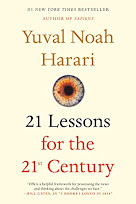
21 Lessons for the 21st Century, Yuval Noah Harari, 2018

Rating: 3/5

This is Harari’s third book — Sapiens looked at the past, Homo Deus explored the future and 21 Lessons discusses the present. My ranking of these three books is also in the same order.

This book is a collection of 21 essays divided in 5 sections with all of them neatly fitting into a cohesive narrative, perhaps fitting too neatly in some cases —the conclusion of each essay segues into the beginning of the next and that sometimes seems forced. What also seems forced are some of the essays which either hold no lessons for the reader or the lessons sound too glib — perhaps they were included to enable the alliterative title of the book!

In essence, Harari is a libertarian but still explores the current shortcomings of liberal democracy so that it can be improved and made more sustainable. Harari explores quite a few interesting ideas through the book. For example, in Work, he sees the need for combining a universal basic income with meaningful pursuits for humankind if AI makes most jobs redundant. He underscores the difference between intelligence and consciousness in Liberty. He explores the concept of the rich becoming a superhuman race, due to biotechnology, in the chapter on Equality. In Nationalism, he bemoans the fact that even as the increasing nuclear, ecological, and technology challenges need to be solved by a concerted global attempt, nationalism is on the rise. He explores racism versus culturism in Immigration. In Education, he makes the point that in 1018, we knew that the world would look the same in 1050 and could prepare for it. Today, we don’t know what the world will be like in 2050. The essay on Secularism was my favourite. With great clarity, Harari explains why it is not a simple negation of religion. 

There is absolutely no doubt about the fact that Harari is a fantastic thinker with insightful views on multiple topics, and a 3/5 rating perhaps seems a bit unfair. But besides some essays being force-fitted, I found some of his arguments specious, such as the one about the irrelevance of a majority of humankind —in the new world fuelled by technology, this majority will ultimately be consumers (of advertising for example in the case of Google) or suppliers (of data). Another example is his underestimation of the power of revolutions if inequality widens. This may be of a different kind from earlier ones in the history of humankind but there will likely be one nevertheless. Harari also uses several examples to make each point. While that can be interesting at times, it also sometimes makes this book a tedious read.

Pros: Insightful views on varied topics

Cons: Some essays seem force-fitted, a bit tedious

Thursday, August 20, 2020

Various Hercule Poirot mysteries, Agatha Christie, 1920 to 1933

Rating: 5/5

It had been a while since I had read an Agatha Christie and with some trepidation (often, I've had bad experiences while revisiting things that I had enjoyed when much younger), I picked up the first of the Hercule Poirot (for me, Agatha Christie equates to Hercule Poirot) books, The Mysterious Affair at Styles. To my great surprise, I found that the joy of reading a Christie remains unabated -- I still find her books well-written, the plots well-fleshed out, Hercule Poirot still as clever as ever and overall, her books remain page-turners. I ended up reading three more of Poirot's early mysteries -- The Murder on the Links (#2), Peril at End House (#8), and Lord Edgware Dies (#9), all within a span of 12 days.

If I had to rank these four books in order, it would be Styles, Edgware, Links and End House. I have a fondness for Styles for it introduces Poirot. In this, he investigates the murder of an old, rich, and autocratic woman, who recently married a man 20 years her junior. In Edgware, a beautiful actress wants to get rid of her husband so that she can marry another, and sure enough, he is found dead. Links has the usual elements of a Poirot story -- a dead millionaire and several suspects including his wife, son and a mistress. An added bonus is that Hastings (the Watson to Poirot's Holmes) meets his future wife in this book. End House is slightly different in the sense that Poirot is trying to prevent the murder of a young girl who has had some close shaves in the recent path. For me, this was the most predictable of the four books.

An element of the Poirot books that I really love is the end denouement in which Poirot gathers all the characters of the story and reveals the identity of the murderer, after detailing out his thought process. Not all his books have this, and I prefer those that do. This style of denoument was actually an act of serendipity. In Styles, Christie had initially written a different climatic scene where Poirot reveals the murderer's identity in a courtroom. Her publisher protested that such an event was implausible, forcing Christie to rewrite the end. The legions of Poirot fans should be grateful to this publisher! As a bonus in the Styles edition that I read, the original courtroom climax is included as an appendix. Besides this aspect, all the Poirot books are cleverly plotted, have multiple suspects, enough red herrings and directs the reader's suspicions from one character to another through the book.   

The only complaint, if any, is that Christie keeps some important plot elements from the reader and only Hercule Poirot is aware of those. But then I am okay with this -- when I read the books, I enjoy the flow of the plot and do not necessarily attempt to play detective.

Pros: Cleverly plotted, page-turner, the usual denouement and of course, the inimitable Hercule Poirot

Cons: Some important plot elements are kept from the reader

Monday, August 10, 2020

Kafka on the Shore, Haruki Murakami, 2002


Rating: 4/5

Kafka on the Shore is your typical Murakami book -- it is surreal and has magical or supernatural elements strewn about the book, has hidden messages not all of which is clear even at the end, but is extremely interesting overall.

The book is centred around two main characters -- Kafka Tamura who runs away from home to escape a prophecy and searches for his mother and sister, and Nakata, an old simple man who had a life-altering experience when young. and can now speak to cats. During their journey, we come across an imaginary person who is Kafka's advisor, fish that rain from the skies, a man who kills cats and stores their hearts in his refrigerator, a middle-aged rich woman who evokes Kafka's Oedipal complex, a transgendered gay man, alien abduction, soldiers lost in a forest who never get old, and several similar elements. The title itself refers to a painting and a song besides referencing the lead protagonist.

The book explores the fine line between imagination and reality through the book, and the distinction often blurs for the reader. The explanations for many of the occurrences in the story are never completely clear and Murakami allows the reader to make her own interpretations. As he himself puts it, the book contains several riddles, but there aren't any solutions provided. The form the solutions take will be different for each reader. It's one of the books where the journey is infinitely more interesting than the destination and plenty of wonderful thought-provoking quotes enhance that enjoyment.

Murakami is not for everyone, however. Some readers may be put off by the large extent of surrealism and even for those that enjoy it, parts of the story are left unexplained which can be somewhat unsatisfactory. However, most of his books are page-turners, delightful to read and provides the reader ample opportunity to contemplate the hidden meanings and nuances and Kafka on the Shore is no different. And that's what makes this a wonderful book to read!

Pros: Extremely interesting and page-turning, thought-provoking

Cons: Some readers may find this too surreal, no clear explanation for some aspects of the story

Thursday, July 30, 2020

Exhalation, Ted Chiang, 2019

Rating: 4/5


Exhalation is a collection of nine short stories with varying lengths, from 3 pages to over 100 pages. Each of them combines science fiction with human emotions such as longing, love, greed, regret and redemption, and that combination makes many of these stories incredible reads.

Most of these short stories had been published previously, but nevertheless, the range of ideas that these stories explore and the imagination behind them is extremely impressive. These nine stories cover a gamut of ideas that include a doorway that allows one to travel 20 years, intelligent digital objects, a robotic nanny, the ability to recall any memory instantly, and a device to communicate with oneself in other branches of the universe.

My favourite stories include The Merchant and the Alchemist’s Gate, written like an Arabian Nights story, that uses time travel to explore lessons learnt by the protagonists from their experiences. In The Truth of Fact, the Truth of Feeling, Chiang explores the delicate balance between mimi (what one considers right) and vough (a precise fact) through two sub-stories involving colonised tribesmen's struggles with written words replacing oral memories and a modern world where humans can recall any memory instantly. Anxiety is the Dizziness of Freedom explores greed, regret and redemption using the many-worlds interpretation of quantum mechanics, in which humans can communicate and collaborate with versions of their self in other branches of the universe.  

The problem with anthologies, as to be expected, is one of mixed quality of the stories. For example, and the reason for only a 4-star rating, The Lifecycle Of Software Objects takes up a third of the book and fails to grip. It talks about the gradual maturing of AI objects (called digients) and their ability to experience love, independence and even sexual attractions. But overall, Chiang's imagination, the variety in the stories, and the underlying messages in them make Exhalation a satisfying read.

Pros: Very imaginative, wide range of ideas, couples science fiction with human nature, well-written

Cons: Disparate quality with a less interesting story taking a third of the book