Monday, May 4, 2026
The Ministry of Time, Kaliane Bradley, 2024
Saturday, August 23, 2025
The Miracles of the Namiya General Store, Keigo Higashino, 2012
Keigo Higashino’s The Miracles of the Namiya General Store is one of those books that left me unsure of where exactly to slot it. Is it a self-help novel? Not quite, as much of the advice presented in the book is half-baked. Is it magical realism? Perhaps, though the magical element is understated. Is it simply a collection of interlinked short stories? That feels closer, but still not the full picture. The book weaves advice columns, time slips, and personal dilemmas into something that resists neat categorization. For some readers that slipperiness will feel refreshing, for others a little unsatisfying.
The premise is undeniably charming: people write letters to the long-closed Namiya General Store seeking advice, and three young delinquents hiding out there decide to answer them. What follows are a series of tales that link the past, present, and future in curious ways. The advice itself, however, often feels scattershot. Sometimes it seems sensible, at other times vague, and in a few cases it takes the “easy way out” by leaning on knowledge of the future, which raises questions about how meaningful or fair that guidance really is. What lingers most from the novel is its intricate web of connections across time. Characters from seemingly unrelated chapters end up linked — by chance, by fate, or by their shared history at a children’s home that recurs through the book.
The trio at the heart of the frame story are sharply drawn. Atsuya, hot-headed and impulsive, wants quick solutions. Shota, in contrast, tends to pause and think things through. Kohei, the quietest of the three, often mediates between them. However, their character arcs do not get fully fleshed out and seem somewhat abrupt.
Higashino’s prose, at least in translation, is simple and elegant. The language flows easily, never bogging the reader down with unnecessary complexity. This makes the book accessible even when the structure is fragmented. Overall, I would give The Miracles of the Namiya General Store a 3 out of 5. It is touching in parts and often clever in how it connects disparate lives, but the unevenness of its advice and the overreliance on coincidence keep it from being truly remarkable.
Pros: An intriguing premise, simple and elegant
Cons: Uneven advice sections, heavy reliance on coincidence
Thursday, March 20, 2025
Vera Wong’s Unsolicited Advice for Murderers, Jesse Sutanto, 2023
One of the book’s biggest strengths is its charming protagonist. Vera Wong is a delightful character—nosy, opinionated, and utterly endearing. Her habit of dispensing unfiltered, maternal advice (and food and tea) to everyone she meets is both amusing and oddly heartwarming. The novel also shines in its depiction of found family. As Vera cozies up to the suspects — Riki, Oliver, Julia, and Sana — what begins as suspicion gradually transforms into friendship. The group’s growing bond adds warmth , making the story feel more like a character-driven drama than a whodunit. The book also offers gentle but thoughtful commentary on loneliness, immigrant experiences, and generational disconnect.
However, despite these positives, the book ultimately fell a bit flat for me, warranting a 3/5 rating. While the mystery element is what drew me in, it ended up feeling secondary to the relationships and tea-time bonding. The investigation itself is simplistic and lacks the tension or twists that make a mystery gripping. Vera’s sleuthing relies more on charm and intuition than genuine detective work, making the “solving” of the crime feel almost incidental. Additionally, the writing style, while breezy and accessible, often veers into being overly sweet and sentimental. The characters’ emotional arcs, though touching, felt predictable and saccharine, with conflicts tied up too neatly.
That said, Vera Wong’s Unsolicited Advice for Murderers will likely appeal to many readers, especially those looking for a cozy, heartwarming read with a sprinkle of mystery. Fans of character-driven stories, particularly ones featuring quirky older protagonists, will enjoy Vera’s antics and her lovable meddling. The book’s themes of loneliness, redemption, and human connection give it a relatable emotional core. While I found the book a bit too sugary and simplistic for my taste, still, it offers a pleasant escape — like a cup of sweet, milky tea on a rainy afternoon: comforting, but not particularly memorable.
Pros: Charming protagonist, heartwarming, and gentle commentary on loneliness and connection
Cons: Simplistic mystery, predictable emotional arcs, and overly saccharine tone
Sunday, July 21, 2024
Close to Death, Anthony Horowitz, 2024
In the world of murder mysteries, Anthony Horowitz stands out for his diverse approach. His books defy convention, and “Close to Death” is no exception. I have read four previous Hawthorne books—the first two were Susan Ryeland mysteries, structured as books within books. One even featured Sherlock Holmes. The fourth book saw the author playing sidekick to investigator Daniel Hawthorne in a true crime novel. Now, in “Close to Death,” Horowitz revisits an unsolved case from years ago, getting involved with Hawthorne long after the crime occurred. However, this desire to be unconventional did not work for me this time, but more about that later.
Detective Hawthorne tackles an unsolvable murder in Riverside Close, an idyllic gated and wealthy community. The entire set-up is very Agatha Christie-like, an obvious inspiration for Horowitz in many of his books. The Close consists of six houses occupied by a hedge fund manager and his wife, a chess expert and his Asian wife, a dentist and his invalid wife, a conscientious doctor-designer couple, a widowed lawyer, and two ex-nuns. The least liked person is killed, and everyone else seemingly has a motive, however trivial it may be. Horowitz uses this murder, committed several years ago, as the basis for his new book.
Once again, Horowitz blends reality and fiction, keeping himself as a character alongside Hawthorne. Juggling multiple timelines, Horowitz keeps readers engaged and guessing. The supposed murderer is revealed exactly midway through the book, and it’s left to Horowitz to piece together the real story behind the murder. While this eventually justifies the “meta” structure of the book, it is distracting and weary during the first half. On the plot itself (which is the most important part of any murder mystery), the eventual resolution is far from satisfying—while the author has scattered a few clues throughout the book, it could have been resolved in so many different ways, and I don’t think it is possible for readers to work it out themselves.
While Horowitz’s ambition is admirable, it occasionally hampers the book’s flow. Eventually, I felt that Horowitz’s desire to be unconventional sometimes overshadowed the plot.
A bonus: Horowitz rants about his dislike for locked-room mysteries in the middle of the book but helpfully suggests a couple of good ones for lovers of that genre: “Murder in the Crooked House” by Soji Shimada, and “The Honjin Murders” by Seishi Yokomizo.
Pros: Engaging, Agatha Christie-like setting
Cons: Weary meta structure at times
Wednesday, June 1, 2022
Hickory Dickory Dock, Agatha Christie, 1955
It’s rare for an Agatha Christie-Hercule Poirot novel to disappoint me but Hickory Dickory Dock is one of those. The book starts off with a series of thefts of mainly minor items (such as a stethoscope, lightbulbs, and boracic powder) and some trivial but vicious acts (such as a slashed rucksack and spilt green ink on someone’s notes) at a youth hostel located on Hickory Road run by the sister of Poirot’s secretary. Poirot gets attracted to the case due to its ordinary yet seemingly perplexing nature. Soon thereafter, there is a murder and events unfold true to the nature of a Christie novel.
There are a few things to like about the book. It is short and a page-turner, there are several characters that have interesting back stories and who could be the killer, and the unconnected events are neatly untangled at the end.
However, as I mentioned at the outset, the book does disappoint on various counts. First, while the title is a continuation of Christie’s practice of using nursery rhymes, the connection is extremely tenuous in this case. The hostel is located on Hickory Road and there is some brief reference to people “being in the dock” but that’s about all the connection there is. Second, when I re-read Christie’s books, I can’t help but notice the racist treatment of some characters in some of the novels. Well, it was written 67 years ago, so perhaps we can ignore it. Third, it is not clear how Poirot arrived at some of the conclusions that helps him solve the crime. There is no way in which readers can solve this themselves and that feels a bit unfair. Fourth, and this is perhaps a minor thing, I enjoy the dynamics between the investigating officers and Poirot is many of the books — the police holding Poirot’s views in contempt initially and then recognising his abilities eventually. Finally, and importantly, the best part of the Poirot books for me is the eventual denouement where Poirot gathers all the characters in one place and explains how he solved the case. That is sadly missing in this book. So, this is not a book that I intent to re-read ever!
Pros: Page-turner, unconnected events that neatly fit together at the end
Cons: No final denouement, all the steps behind Poirot’s solution are unclear, disappointing title
Monday, February 14, 2022
Never, Ken Follett, 2021
However, what could have been a compelling political thriller becomes a mishmash of government manoeuvres and personal stories of some of the protagonists. The 800-page length consequently seems unnecessary — the entire track covering an undercover CIA agent in Chad and a mother-son duo from one of the Chadian settlements seems irrelevant and has very little bearing on the main plot, for example. Some of the personal side-stories are somewhat jarring and long, like the ones covering the lives of US President Pauline Green and her husband and daughter or even the relationship between a CIA operative and a French attache in Chad. The romantic tracks are awkward at best — when one of the key protagonists voices that “a woman’s heart can be an unexploded bomb … handle me delicately so that I don’t detonate”, you know that this isn’t Follett at his best. Foes of some of the main characters are reduced to caricatures. In a way, Never reminded me of the old Sidney Sheldon books — I would gobble them greedily when I was younger but would probably get nauseous reading parts of them now.
Given its length, the book is mercifully an easy read. However, only parts of it are real page-turners such as an escape from a terrorist camp or the spiralling of events towards the end. While I wasn’t tempted to leave the book unfinished at any point, Never was a bit of a lost opportunity to be a great book, in my view.
Pros: Epic story, easy read
Cons: Unnecessary length, awkward personal tracks
Saturday, December 25, 2021
The Word is Murder, Anthony Horowitz, 2017
Horowitz has mastered the art of crafting detective stories differently, in a meta format. For example, in Magpie Murders, the clues to the mystery reside in another book that’s embedded within the main story. The Word is Murder is structured in the form of a true crime novel where Horowitz himself plays a role as the biographer of fictional detective Daniel Hawthorne during the process of solving a murder. Diana Cowper is found strangled a few hours after she visits a funeral parlour to plan her own funeral. Key characters in the mystery include her son and his girlfriend, her maid, a producer friend, and a family who was hurt in a car accident caused by Diana. Daniel Hawthorne, a detective, contacts Horowitz to write a book about himself and offers him a role in investigating Cowper’s death.
True to his style, Horowitz structures his detective story interestingly — he intersperses actual events in his life (such as the publication of his novels and involvement with TV and movies) with the fictional role that he plays in the murder mystery. After a while, it’s difficult to separate fact from fiction and Horowitz uses this style to dwell on the process and challenges of writing novels. You can imagine him having a quiet chuckle when his fictional self writes about how he accepts Hawthorne’s offer as a shortcut to write a new murder mystery, without doing much research. Or when that fictional self talks about his insecurities around missing out on opportunities that could possibly be life-changing or of saying the wrong things in a literary event with journalists present. This does have its jarring moments though. At one point, there is an entire chapter on a tangential narrative of his involvement with Spielberg’s Tintin movies (which is part real and part fiction), which has no bearing on the story. But there are the parts that makes one think too, like the time when he was trying to make television viewers try to understand the turning away of a gay couple from a hotel from the homophobic owner’s point of view but got pilloried — “we need to tolerate intolerance” as he puts it.
The build-up is top-notch and makes this book a page-turner — Horowitz throws lines early in the book, such as one where he indicates that the first chapter includes a clue that quite clearly identifies the killer or the one where he regrets getting involved because of what happens later, that hooks the reader completely and builds anticipation. And like all good novels, there are enough clues strewn about that would make the reader feel that they could have solved the mystery.
But eventually, I will not rate this among the finest murder mysteries that I have read. Unlike Agatha Christie’s Poirot or Arthur Conan Doyle’s Holmes, Hawthorne is an extremely unlikeable person. Even the more recent Strike from Robert Galbraith’s (JK Rowling) books tends to be brusque, but you can still root for him. And you need a protagonist that you can root for! Hawthorne’s homophobia is also quite apparent early in the book and while Horowitz’s character expresses his displeasure at it, he continues working with Hawthorne and this apparent conflict remains unresolved even at the end. Also, while a Dr. Watson or a Dr. Hastings come across as nincompoops occasionally, it’s easy to empathise with them and their relationships with the main detectives are endearing. Horowitz, on the other hand, comes across as a weak person, a poor foil to Hawthorne, has no chemistry with the detective and for a successful writer, some of his actions are inexplicable. So, for me, this book gets full marks for the writing style but is an average detective story otherwise.
Pros: Clever structure, page turner
Cons: Unlikeable protagonists
Sunday, September 12, 2021
The Financial Expert, R K Narayan, 1952
Books like PG Wodehouse’s for example age very well despite the fact that the idyllic world that they are set in and societal norms that they refer to are completely unrecognisable today. And that is due to the romanticisation of any situation and the ample use of humour. I have always viewed RK Narayan as an Indian version of Wodehouse with his semi-rural South Indian locales, quaint characters and understated and wry humour. His world of Swamy, for example, has provided endless delight to me and I’m sure to generations of readers. However, The Financial Expert, frankly, was somewhat disappointing — the plot was too simplistic and the humour rare to find!
This book, like most of his other stories, is based in the fictional town of Malgudi in southern India with the characters and their milieu being similar to his usual ones. Margayya (literally the person who shows the way) is the resident financial expert who helps the villagers inveigle loans from the local co-operative bank but aspires for more wealth and respect from his fellow citizens. His journey towards that goal forms the crux of the novel and his long-suffering wife, his spoilt son Balu, and Dr. Pal, a bohemian author, play important roles in that journey.
Narayan has managed to imbue his central character of Margayya with multiple facets to his nature — greedy, miserly, pompous, sensitive, self-righteous yet one who appears simple at his core. His relationship with his wife is the one that Narayan has captured the best, he’s usually dismissive of her yet tender on occasions. Parts of the plot, like his engagement with his clients, his conflict with the co-operative bank officials, his encounter with the local priest, his hunt for a red lotus and his experience as a publisher have subtle humour and irony and are a delight to read. His writing is simple (perhaps a bit too simple at parts) and easy to read. However, the story and the writing does drag on for a significant part of the book. The beginning of the book is extremely promising with Margayya doling out advice to his customers under a banyan tree outside the co-operative bank but the narrative surprise peters out in the second half of the book.
Surprisingly, while this movie was adapted for an award-winning Kannada movie, it has not been recreated in any of the mainstream languages. Malgudi Days, Narayan’s collection of short stories, was made into an absolutely delightful TV show back in 1986. I will hope that the same is done with The Financial Expert!
Pros: Subtle humour, quaint characters and milieu
Cons: Second half was simplistic and dragged
Wednesday, August 26, 2020
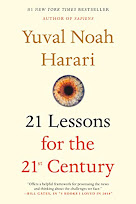
21 Lessons for the 21st Century, Yuval Noah Harari, 2018

Cons: Some essays seem force-fitted, a bit tedious
Saturday, May 23, 2020
Little Fires Everywhere, Celeste Ng, 2017
There are three things that I seek from a good piece of fiction: (1) Great plot, (2) Good writing, and (3) Post-read mulling. In Little Fires Everywhere, I thought the plot was okay, the writing mediocre, and I can't wait to finish this review and move on to the next book!
The premise of the book is interesting and it starts with promise, highlighting the title of the book and making us want to understand its meaning. The book could have been an interesting study of class differences and racial tensions through its diverse array of characters. There is the seemingly perfect Richardson family -- husband Bill, supercilious but thwarted Elena, clueless Trip, superficial Lexie who then has a life-altering experience, strait-jacketed Moody and the rebellious Izzy (my favourite and I suspect that of most readers). We have the mother-daughter duo of Mia and Pearl with a secretive past who are completely unlike anyone the Richardsons know and who manage to upend their lives. Even some of the relatively minor characters such as Bebe Chow have promise. However, critical parts of the plot (Mia's dark secret, for example) are so improbable, that they make some of the characters look artificial and make it difficult to remain vested with them. The class-related and racial issues are also treated quite superficially.
The writing was disappointing for me as well. As I read, I usually highlight sentences whose construct I find particularly interesting or which I can quote at a later date. I ended up highlighting nothing in this book! Popular highlights on the Kindle include sentences such as: It was like training yourself to live on the smell of an apple alone, when what you really wanted was to devour it, to sink your teeth into it and consume it, seeds, core, and all.
The writing, and the plot to some extent, seem contrived at places. Nothing underlines this as much as the description of the artwork created by Mia for different members of the Richardson family towards the end of the book. That was the last straw for me!
Pros: An easy read, interesting premise
Cons: Trite writing, improbable plot developments